Back
Contact us

Why Is Ammonia Used in Industry?

Ammonia is easy to overlook. Yet it sits behind familiar products, from crop fertilizers to cleaning agents, and supports several major industrial processes. Its sharp smell may be what people notice first; its larger importance is less visible. Ammonia is made in enormous quantities because it carries nitrogen in a form that manufacturers can use, store, and move. That practical role has shaped modern agriculture and chemical production.

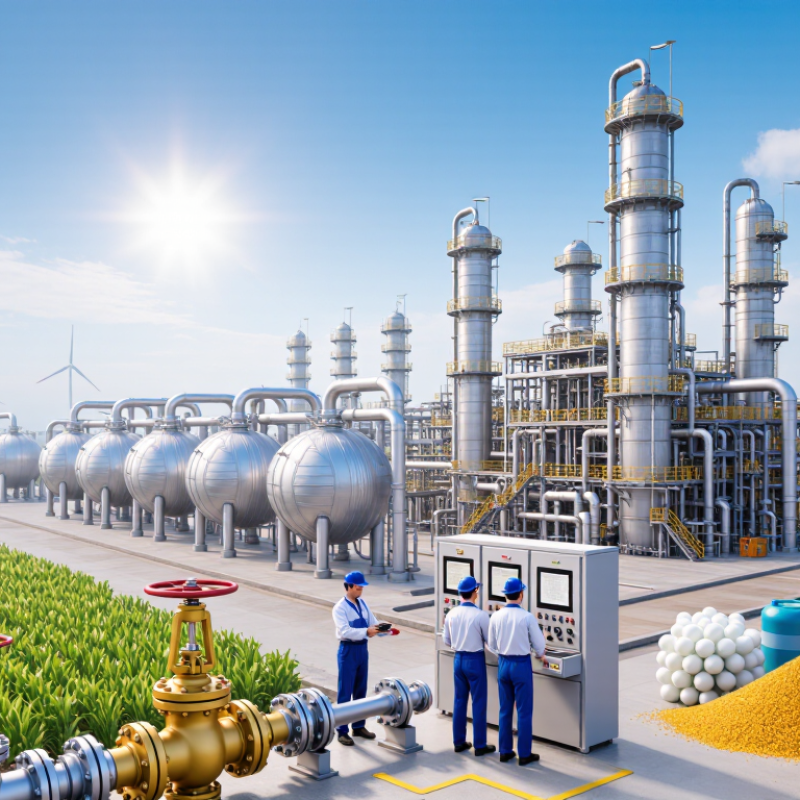
Historian of technology Vaclav Smil has called the Haber-Bosch process “arguably the most important technical invention of the twentieth century.” The process combines nitrogen and hydrogen to produce ammonia. In a plant, operators control pressure, temperature, and catalysts with care; pipes, compressors, and monitoring systems do the quiet work. The result becomes a key ingredient in nitrogen fertilizers, which help crops grow and support food supplies. Ammonia also serves as a feedstock for products such as nitric acid, plastics, and synthetic fibers. Its value is not mysterious. It is useful chemistry at industrial scale.

But the story is not entirely simple. Conventional production consumes substantial energy and can generate significant carbon emissions. That matters. Newer approaches aim to lower the climate impact, though their costs, energy needs, and infrastructure remain important questions. It would be too neat to call ammonia either a perfect solution or merely a problem. Its industrial uses are deeply established, while its production methods still need scrutiny. Understanding why industry relies on ammonia means looking at both sides: what it makes possible, and what its production demands.
Why Is Ammonia Used in Industry?

Chemical Properties That Make Ammonia Useful in Industry

Ammonia’s value starts with its compact chemistry. Each molecule contains one nitrogen atom and three hydrogen atoms, making nitrogen about 82% of its mass. That concentrated supply helps explain its role as an industrial feedstock. Ammonia dissolves readily in water and behaves as a weak base, so it can support controlled chemical processes and produce useful nitrogen compounds. The International Energy Agency’s 2021 Ammonia Technology Roadmap reports that roughly 70% of global ammonia use goes to fertilizers. It also records production of about 185 million tonnes in 2020. Those figures show how strongly industry depends on a molecule with straightforward chemistry.

Its physical properties matter, too. Ammonia boils at about −33°C at atmospheric pressure, so facilities can store it as a liquid using refrigeration or pressure. Liquid storage makes large-volume handling practical, though it requires carefully designed equipment. There is a trade-off. Ammonia is toxic, and its sharp smell should never replace leak detection or safety controls. The IEA report also highlights ammonia’s potential as a hydrogen carrier, because it contains hydrogen and can be transported as a liquid. That prospect is useful, but conversion back to hydrogen takes energy. Chemistry makes ammonia versatile; it does not make every application simple.

Why Is Ammonia Used in Industry?

Ammonia’s nitrogen content, water solubility, and ability to act as a base make it useful across many industrial processes.

About 70% of global ammonia is commonly estimated to go toward fertilizer production, with the remainder used in applications such as chemicals, refrigeration, and emissions control. Shares vary by year and source.

Ammonia dissolves readily in water and forms an alkaline solution, making it useful in cleaning and chemical manufacturing. Its nitrogen is also a key ingredient in fertilizers, while its evaporation at low temperatures makes it useful as an industrial refrigerant.

How Ammonia Is Produced and Supplied

Production Most industrial ammonia is made through the Haber–Bosch process. Nitrogen is separated from air, while hydrogen often comes from natural gas. Water electrolysis can provide hydrogen too, when suitable low-carbon electricity is available. The gases react over a catalyst at high temperature and pressure. Unreacted gases return to the process, and the ammonia is cooled until it condenses. The chemistry is well established; its energy demands are harder to ignore.

Storage & Transport Ammonia is usually stored and transported as a liquid, either under pressure or at low temperature. Depending on the route and quantity, it may travel through pipelines, rail tank cars, ships, or road tankers. At receiving sites, closed transfer lines and leak-detection systems help limit exposure. Ammonia has a sharp odor, but smell is not a dependable safety measure. The vapor can harm the eyes and lungs. Small details matter, including valve checks and clear emergency procedures.

Supply & Reliability Supply planning links production sites to fertilizer plants, chemical manufacturers, and other users. Storage can help balance uneven deliveries, but it requires suitable tanks, trained operators, and careful monitoring. A simple account can make the chain sound seamless. It is not always so: energy costs, maintenance, weather, and transport capacity can all affect delivery schedules. Even efficient production leaves a practical question: how can supply stay reliable while its energy footprint falls?

Major Industrial Uses of Ammonia

Why Is Ammonia Used in Industry?
Major Industrial Uses of Ammonia

Ammonia is a practical starting material for products that support food production and manufacturing. The International Energy Agency’s 2021 Ammonia Technology Roadmap estimates that global production reached about 185 million tonnes in 2020; roughly 70% went to fertilizers. Farmers use ammonia-based products to supply nitrogen, an essential nutrient for crop growth. Urea and ammonium nitrate are common examples. The figures are estimates, and reporting methods can vary.

Beyond fertilizers, manufacturers use ammonia to make nitric acid, which feeds into the production of chemicals and materials. It also serves as a refrigerant in large industrial cooling systems, where it can chill food-processing rooms and cold-storage warehouses. Some power plants and industrial facilities use ammonia in emissions-control systems to reduce nitrogen oxides in exhaust gases. Each application needs careful handling: ammonia is pungent and can harm people if released. Useful, but not harmless.

Tips: In a cold-storage facility, check that ventilation, leak detection, and staff training suit the system’s scale. A process that works well on paper may need adjustment in real operating conditions.

Why Ammonia Matters in Agriculture, Manufacturing, and Refrigeration

Ammonia matters because it links crop production, chemical manufacturing, and industrial cooling. The International Energy Agency’s Ammonia Technology Roadmap (2021) estimates that global production reached about 185 million tonnes in 2020, with roughly 70% used for fertilizers. Ammonia-derived nitrogen helps crops such as wheat and maize grow. The benefit depends on careful application: excess nitrogen can be wasted and contribute to air and water pollution. More fertilizer is not always better.

Manufacturers also use ammonia to make products such as urea, nitric acid, and synthetic fibers. In large cold stores and food-processing plants, it serves as an industrial refrigerant. ASHRAE’s Handbook—Refrigeration describes ammonia’s established role in industrial refrigeration. Its efficiency is useful, but the choice is not plug-and-play: ammonia is toxic at high concentrations, so system design, monitoring, and trained operators matter. That practical constraint is easy to understate.

Tips: Match ammonia use to the process, check equipment compatibility, and plan for leak detection and maintenance. Ask suppliers for current safety documentation and emissions data. A technically sound system can still fall short if its daily operation is overlooked.

Safety and Environmental Considerations in Industrial Use

Why Is Ammonia Used in Industry?
Safety and Environmental Considerations in Industrial Use

Ammonia’s usefulness comes with a sharp, practical hazard: a leak can irritate or burn eyes, skin, and lungs. Workers near pipes, valves, and storage vessels need leak detection, ventilation, training, and suitable protective equipment. NIOSH recommends exposure limits of 25 ppm over a workday and 35 ppm over 15 minutes; its immediately dangerous to life or health level is 300 ppm (NIOSH Pocket Guide to Chemical Hazards). These are not interchangeable thresholds. A small reading still deserves attention.

Containment matters beyond the plant. Ammonia entering waterways can harm fish; risk depends on concentration, water pH, and temperature (U.S. EPA, Aquatic Life Ambient Water Quality Criteria for Ammonia—Freshwater, 2013). Drain isolation and prompt, trained response can limit a release. Details matter. Yet response plans can look neat on paper and falter during a real alarm, especially when procedures are unfamiliar.

There is also a climate cost upstream. The International Energy Agency’s Ammonia Technology Roadmap (2021) estimates ammonia production accounts for about 2% of global final energy consumption and 1.3% of energy-related CO2 emissions. Lower-carbon production can reduce that burden, but it does not remove local leak risks. Industrial users need to manage both—and revisit whether their safeguards work in practice.

Why Is Ammonia Used in Industry? — Safety and Environmental Considerations
Dimension Data or Industrial Role Safety or Environmental Consideration
Fertilizer production Ammonia is a major source of nitrogen for fertilizers and is also used to manufacture other nitrogen-based products. Releases can harm people and contribute nitrogen to ecosystems. Prevent leaks and manage fertilizer-related runoff to reduce water pollution and eutrophication.
Industrial refrigeration Anhydrous ammonia (R-717) is used as a refrigerant, particularly in large industrial refrigeration systems. A leak can create a toxic inhalation hazard. Systems require suitable materials, ventilation, leak detection, emergency procedures, and trained operators.
Chemical manufacturing Ammonia is a feedstock for products including nitric acid and other nitrogen-containing chemicals. Closed handling systems and process controls help limit worker exposure and accidental releases.
Boiling point Approximately −33.3 °C at atmospheric pressure. Liquefied ammonia can rapidly vaporize if released. Contact with escaping liquid can cause severe cold burns, in addition to chemical injury.
Water solubility Ammonia is highly soluble in water. It can dissolve in moisture on the eyes, skin, and respiratory tract and cause corrosive injury. Ammonia entering water can also be toxic to aquatic life.
Vapor behavior Ammonia vapor is lighter than air under the same conditions, although a released plume’s movement also depends on temperature, moisture, and airflow. Do not assume a release will simply rise or disperse safely. Site-specific ventilation, monitoring, and emergency planning are important.
Worker exposure limits (United States) OSHA’s permissible exposure limit is 50 ppm as an 8-hour time-weighted average. NIOSH recommends 25 ppm as a time-weighted average and 35 ppm as a short-term exposure limit. These are occupational reference limits, not guarantees that every person will be protected. Applicable requirements vary by jurisdiction; use monitoring and appropriate respiratory protection when required.
Immediately dangerous concentration NIOSH lists 300 ppm as the immediately dangerous to life or health (IDLH) concentration. IDLH conditions require specialized emergency procedures and appropriate supplied-air respiratory protection; unprotected entry is unsafe.
Flammability Ammonia is flammable at relatively high concentrations in air; published flammable limits are approximately 15% to 28% by volume. Although its flammability range is narrower than that of many common fuels, ignition and explosion hazards are possible under suitable conditions. Control ignition sources and follow process-safety requirements.
Aquatic effects Ammonia is toxic to aquatic organisms. Its toxicity depends on factors including concentration, pH, temperature, and the proportion present as un-ionized ammonia. Prevent discharges and promptly contain spills. Avoid treating a single concentration as a universal safe threshold for all waters or species.
Key risk controls Common controls include closed transfer systems, compatible equipment, ventilation, gas detection, preventive maintenance, and worker training. Facilities should maintain site-specific emergency plans, suitable protective equipment, and procedures for isolation, evacuation, and release response.
Reference note: Exposure figures above are U.S. OSHA and NIOSH values. They are included for general information; applicable regulations and safe operating practices depend on location, process, and site conditions.