
Back
Contact us

What Are the Top 10 Extrusion Shapes for Buyers?

Extrusion Shapes are chosen for more than their outline. A profile must fit the load, assembly method, finish, and space available in the final product. Buyers often compare familiar options such as angles, channels, tubes, bars, T-sections, I-beams, U-profiles, Z-profiles, hollow sections, and heat-sink designs. Each solves a different practical problem. Some provide stiffness with little material, while others create a protected route for wiring or fluids.

This guide examines ten widely used shapes and the details that matter when comparing them. Wall thickness, corner radius, alloy, and dimensional tolerance can affect both performance and cost. A square tube may look simple, yet its internal dimensions can determine whether a connector fits. Heat-sink fins also need suitable spacing for airflow, not just a tidy appearance. Small details matter.

No single ranking suits every project. A shape that works well in a machine frame may be awkward in a compact enclosure. Buyers should confirm specifications with a qualified supplier and review drawings before production, especially when a profile has thin walls or complex hollows. These checks do not remove every uncertainty. They do make comparisons more useful and help prevent avoidable redesigns. The best choice is usually the one that meets the real application requirements without adding complexity that the product does not need.
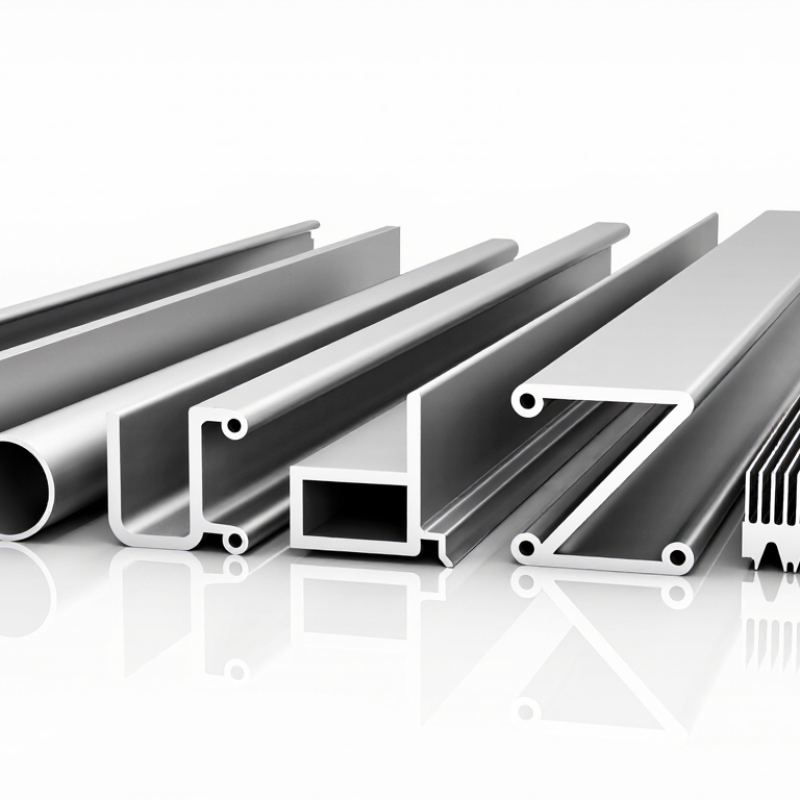
What Are the Top 10 Extrusion Shapes for Buyers?

How Extrusion Profiles Differ: Solid, Hollow, and Semi-Hollow Sections

Extrusion shapes are commonly grouped as solid, hollow, or semi-hollow sections. A solid profile has no enclosed cavity, like a flat bar, angle, or channel. These shapes are often straightforward to inspect and machine. Their weight can add up quickly, though, especially in large frames or long supports.

Hollow profiles contain one or more enclosed spaces, such as the chambers inside a rectangular tube. They can provide useful stiffness with less material than a solid section of similar outer size. Producing them requires more complex tooling, and thin walls may be harder to maintain consistently. Check corner radii, wall thickness, and where fasteners will sit. Small details matter.

Semi-hollow sections have a cavity that opens through a narrow gap. Think of a deep channel with a nearly closed slot. They can combine useful geometry with less complicated tooling than some fully hollow designs, but the opening and nearby walls need careful review. “Nearly closed” is not the same as closed. For buyers, compare the section’s load direction, finish requirements, tolerances, and expected production volume with the supplier’s capabilities. A profile that looks efficient on paper may need adjustment after a prototype reveals awkward assembly or uneven wall behavior.

Six Structural Shapes: Angles, Channels, T-, Z-, I-, and H-Sections

Angles are compact choices for corner bracing, edge protection, and simple frames. Their two legs meet at a right angle, making them easy to attach, though the open shape can twist under uneven loads. Channels add a web between two flanges. They suit rails, supports, and sliding assemblies, but flange spacing and wall thickness affect stiffness. T-sections place a stem beneath a crossbar, useful for ribs, dividers, and mounting features. They can concentrate stress near the junction, so generous transitions deserve attention. Small details matter.

Z-sections have offset flanges that can overlap in layered frames or connect with adjacent panels. Their geometry can be efficient, yet alignment and fastener access may take extra planning. I-sections put material in upper and lower flanges, joined by a central web. They resist bending along a preferred axis, but offer less benefit when loads come from unexpected directions. H-sections have wider, parallel flanges and are often selected for columns, frames, or substantial supports. Their weight and material use can rise quickly. For any of these profiles, compare load direction, span, connection method, and available wall thickness before choosing. A sketch helps, but it does not replace checking actual dimensions and tolerances; that step is easy to underestimate.

Four Utility Shapes: Round, Square, and Rectangular Tubes, Plus Flat Bar

Among common extrusion choices, four utility shapes solve many everyday design problems: round tube, square tube, rectangular tube, and flat bar. Round tube distributes loads evenly around its perimeter and works well for rails, sleeves, and fluid pathways. Its curved surface can be awkward to clamp. A simple fixture may save time.

Square tube offers flat faces for mounting brackets and joining frames. It is often easier to align than round stock, though corner details can affect fit. Rectangular tube provides a useful balance of depth and width. Designers use it when a frame needs stiffness in one direction without adding excessive material.

Flat bar is a solid strip with a broad face, making it practical for tabs, supports, and trim. It is easy to cut and drill, but thin sections can bend during handling. Check the specified alloy, temper, dimensions, and tolerances before ordering. Wall thickness and corner radii matter, especially when parts must slide together or meet another component. I would not assume nominal dimensions guarantee a perfect fit. Measure sample pieces and test the actual assembly. That small check can prevent a frustrating redesign.

What Are the Top 10 Extrusion Shapes for Buyers? - Four Utility Shapes: Round, Square, and Rectangular Tubes, Plus Flat Bar

No. Extrusion Shape Cross-Section Description Common Uses Buyer Considerations
1 Round Tube A hollow circular profile with a consistent wall around its circumference. Frames, handrails, fluid or air conduits, and lightweight structural assemblies. Specify outside diameter, wall thickness, alloy, temper, and whether the tube must meet pressure or structural requirements.
2 Square Tube A hollow profile with four equal sides and a central square opening. Furniture frames, equipment supports, guards, and general-purpose structures. Check outside dimensions, wall thickness, corner radii, straightness, and the intended connection method.
3 Rectangular Tube A hollow four-sided profile with unequal side dimensions. Machine frames, architectural assemblies, vehicle components, and supports where orientation matters. Confirm width and height orientation, wall thickness, corner radii, and the direction of expected loading.
4 Flat Bar A solid, flat rectangular profile with a relatively small thickness compared with its width. Brackets, trims, straps, spacers, and cut-to-length fabrication parts. Specify width, thickness, edge condition, flatness, alloy, and required surface finish.
5 Round Bar A solid circular profile with a uniform diameter. Machined pins, shafts, spacers, fastener blanks, and general fabrication. Check diameter tolerance, straightness, cut length, alloy, temper, and machining requirements.
6 Square Bar A solid profile with four equal sides and a square cross-section. Machined components, supports, tooling, and fabrication requiring flat faces. Confirm side dimensions, corner radii, dimensional tolerance, straightness, and surface condition.
7 Angle An L-shaped profile formed by two legs meeting at a corner. Bracing, edge protection, frames, shelving, and structural connections. Specify leg lengths, thickness, inside corner radius, and whether equal or unequal legs are needed.
8 Channel A U-shaped profile with a web and two projecting flanges. Tracks, frames, equipment supports, cable-management structures, and edge trims. Check overall width and depth, flange dimensions, wall thickness, corner radii, and load orientation.
9 I-Beam A profile with two flanges joined by a central web, resembling the letter I in cross-section. Beams, structural framing, support members, and applications requiring bending resistance in a preferred direction. Confirm section dimensions, alloy and temper, load case, span, and applicable design requirements.
10 T-Section A profile with one flange perpendicular to a central stem, resembling the letter T. Stiffeners, guides, framing, panel supports, and architectural details. Specify flange width, stem height, thickness, corner radii, and how the profile will be joined or supported.

Note: These are common profile types, not a universal ranking. Availability, dimensions, tolerances, mechanical properties, and suitability vary by material, alloy, temper, extrusion process, and supplier. Verify design loads and applicable standards before purchase.

Check 6063-T5 Against ASTM B221’s 145 MPa Minimum Tensile Strength

For buyers comparing ten common extrusion shapes—flat bar, round bar, square bar, angle, channel, T-section, I-beam, Z-section, round tube, and rectangular tube—temper matters as much as geometry. With 6063-T5, check the applicable ASTM B221 requirements and confirm the specified 145 MPa minimum tensile strength applies to your product dimensions. A thin tube and a solid bar can behave differently under load, even when both carry the same alloy and temper designation. Ask for a material test report tied to the shipment, not just a general product sheet. Small details matter.

Tips: Check the alloy, temper, dimensions, and test results together. Measure sample walls with calipers, especially near corners. If the extrusion will be machined or heavily loaded, confirm that the chosen shape suits the actual service conditions.

A certificate offers useful evidence, but it does not replace incoming inspection. Compare the reported tensile value with the relevant specification, and clarify any unclear test method or lot identification before approval. Also inspect straightness, surface marks, and fit against mating parts. I would not choose a profile by strength alone; assembly access and wall thickness can change the result. That judgment is not always obvious from a catalog drawing.

Compare Wall Thickness, Section Modulus, Tolerances, and Die-Cost Trade-Offs

Ten familiar extrusion choices include round rod, square bar, flat bar, angle, channel, T-section, I-beam, Z-section, round tube, and rectangular tube. The label alone says little about performance. Section modulus depends on dimensions and orientation under load. For a shelf bracket, a deep channel may resist bending better than a flat bar. A tube can offer stiffness in several directions. Check the actual load path.

Wall thickness affects weight and manufacturability. Thin tube walls reduce mass, but narrow slots and uneven transitions can make them harder to produce consistently. Specify only the tolerance the assembly needs. Tighter limits can increase inspection and scrap costs. Hollow profiles may also require more involved dies than simple solid shapes. That adds cost. Uniform wall thickness often helps, though die design still depends on alloy, profile perimeter, and press capacity.

Compare options using the same material, span, load, and deflection target. Ask suppliers to review critical dimensions, such as a sliding fit or a 2.0 mm wall. The number is only a starting point; process capability varies. A common procurement miss is overlooking a mating face, then paying for machining later. There is no universal winner. Price the die, expected run volume, and secondary operations together; a slightly heavier channel may prove more dependable.