How to Understand Petroleum Coke Composition?
Understanding Petroleum Coke Composition requires more than reading a single laboratory number. Petroleum coke is a carbon-rich material formed during delayed coking, but its properties vary with crude oil, refinery settings, and processing conditions. James G. Speight, a widely recognized petroleum technology expert, describes petroleum coke as “a solid carbonaceous residue from the refining of crude oil.” This definition is simple, yet the material is not.
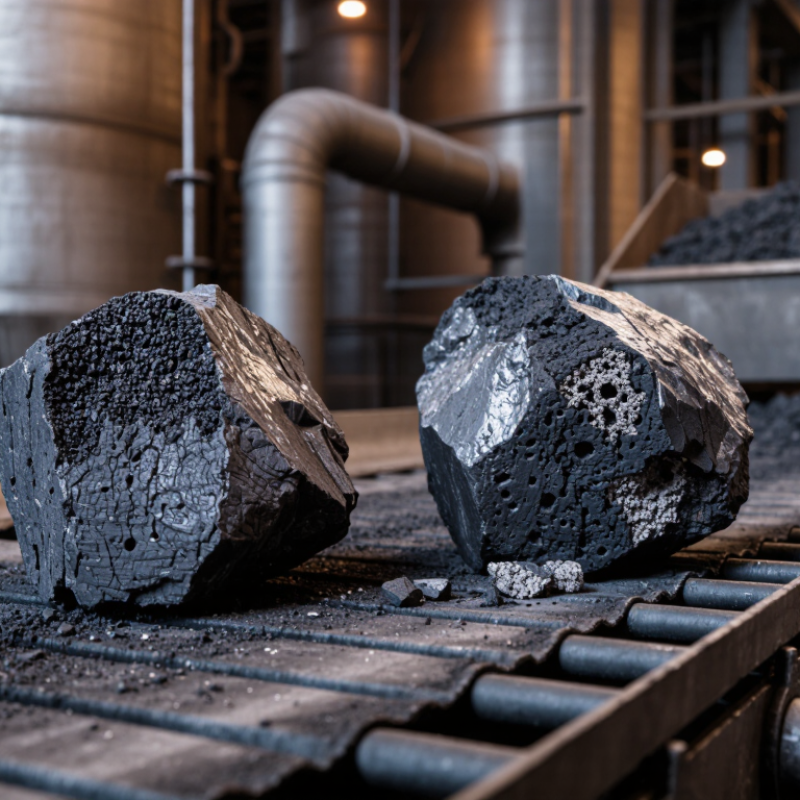
A practical analysis examines fixed carbon, volatile matter, sulfur, moisture, ash, and trace metals. Nickel and vanadium deserve close attention. They can influence combustion behavior, emissions control, and suitability for industrial applications. Porosity also matters, especially when comparing fuel-grade and calcined coke. Two samples may look almost identical beside a storage conveyor. Their chemical performance may differ considerably.
Reliable interpretation depends on representative sampling and consistent laboratory methods. ASTM-based testing can improve comparability, but testing is never perfect. Moisture may change during storage. Fine particles can separate from larger pieces. One sample may not represent an entire shipment.
That limitation deserves attention. Numbers need context.
This guide explains how each component affects quality, handling, and end use. It also considers how feedstock selection and coking temperature shape the final product. Readers will see why sulfur content alone cannot define Petroleum Coke Composition. Experience from refinery operations, laboratory testing, and materials evaluation provides a stronger view.
Some conclusions remain conditional. That is normal.
A careful assessment combines chemical results, physical observations, process history, and documented quality controls. This approach supports more transparent decisions and reduces the risk of judging petroleum coke by appearance alone.
What Petroleum Coke Is and How It Is Produced
Petroleum coke, often called petcoke, is a solid, carbon-rich material formed during oil refining. It is not mined like coal. Instead, it remains after heavier petroleum fractions are processed into lighter products.
Refiners produce petcoke through a process called delayed coking. Heavy oil is heated in large drums under controlled conditions. Thermal cracking separates vapors from the heaviest material. The vapors leave for further refining, while a hard carbon mass remains behind. That mass is called green coke. Water jets later cut it into smaller pieces. Some green coke is calcined, or heated again, to remove volatile compounds and improve its density.
Its composition mainly includes fixed carbon, sulfur, volatile matter, moisture, ash, and trace metals. Sulfur and metals often become concentrated during refining. The exact balance depends on the original crude oil and operating conditions. A single sample is not the whole story. Laboratory testing is essential for reliable evaluation. Technicians may measure sulfur, ash, moisture, volatile matter, and metals before selecting a suitable use.
The term “carbon-rich” can sound simple, but it may hide important differences. Even samples from one facility can vary by batch. Storage conditions may also change moisture levels. Careful sampling and documented testing provide a more accurate picture of petroleum coke composition.
How to Understand Petroleum Coke Composition
Representative composition of green petroleum coke on an as-received basis
Petroleum coke is a carbon-rich solid produced when heavy petroleum residues are thermally cracked in a delayed coking unit. A representative green petroleum coke contains about 88% fixed carbon, 10% volatile matter, 1.5% sulfur, and 0.5% ash by mass. Actual composition varies with crude oil characteristics and refinery operating conditions. Calcination reduces moisture and volatile matter while increasing the relative carbon concentration.
The Main Chemical Components of Petroleum Coke
How to Understand Petroleum Coke Composition?
Petroleum coke is a carbon-rich solid produced during the refining of heavy oil fractions. Carbon usually forms about 80–95% of its dry mass. Carbon dominates. Hydrogen commonly ranges from 3–6%, depending on the feedstock and coking conditions. Sulfur may account for 1–8%, although some grades fall outside this range. Its form matters. Sulfur can exist in several chemical structures, so total sulfur alone cannot describe its behavior during combustion or processing.
Nitrogen is often present at roughly 0.5–2%. Oxygen is usually lower, but it can increase after storage or weather exposure. Petroleum coke may also contain trace metals, including nickel, vanadium, iron, calcium, and sodium. These elements can concentrate during refining and influence ash formation, corrosion, and emissions control. Moisture and volatile matter are not chemical elements, yet they strongly affect handling and laboratory results. That detail matters.
Reliable composition testing combines proximate and ultimate analysis. Sulfur analyzers measure total sulfur, while X-ray fluorescence or plasma-based methods can identify inorganic elements. Sampling deserves equal attention. A single portion may not represent an entire shipment because particle size and segregation change the test result. I would not treat one certificate as a complete chemical profile. Laboratory methods also have limits, and results can shift with moisture correction, preparation, and reporting basis. The chemistry is measurable, but never perfectly simple.
How to Understand Petroleum Coke Composition? - The Main Chemical Components of Petroleum Coke
| Component or Property | Typical Range | Common Reporting Basis | What It Indicates |
| Fixed carbon | 80–95 wt% | As received or dry basis | Represents the solid carbon remaining after volatile matter is released; it is a major indicator of fuel and anode-material potential. |
| Volatile matter | 3–15 wt% | Dry basis | Includes hydrocarbon vapors and gases released during heating. Lower values generally indicate a more thermally mature coke. |
| Sulfur | 1–8 wt% | As received or dry basis | One of the most important quality parameters because sulfur can affect emissions, combustion systems, and the suitability of coke for anode production. |
| Ash | 0.1–2.0 wt% | As received or dry basis | The inorganic residue left after combustion, commonly containing silicon, aluminum, iron, calcium, vanadium, and nickel compounds. |
| Moisture | 0.5–15 wt% | As received basis | Water retained from cooling, storage, washing, or handling. It affects shipment weight, heating value, and handling behavior. |
| Hydrogen | 2–5 wt% | Dry basis | Occurs mainly in residual hydrocarbons and contributes to the coke's volatile matter and heating value. |
| Nitrogen | 1–2.5 wt% | Dry basis | A heteroatom inherited from heavy petroleum fractions; it may contribute to nitrogen oxide emissions during combustion. |
| Oxygen | 0.5–4 wt% | Dry basis | Usually present in oxygen-containing surface groups and mineral compounds; the level can vary with feedstock and processing conditions. |
| Vanadium | 50–2,000 ppm | Dry basis | A trace metal commonly concentrated from heavy crude fractions; it can influence ash behavior, corrosion, and anode quality. |
| Nickel | 20–500 ppm | Dry basis | A naturally occurring trace metal that may affect combustion ash, catalyst contamination, and the suitability of calcined coke for specific applications. |
| Silicon, iron, calcium, and aluminum | Usually tens to hundreds of ppm each | Dry basis | These inorganic elements are commonly associated with mineral matter and are important when evaluating ash content and end-use restrictions. |
| Gross calorific value | 28–35 MJ/kg | As received basis | Shows the energy released by complete combustion and is strongly influenced by fixed carbon, volatile matter, sulfur, and moisture. |
Note: The ranges are representative industry-level values. Actual composition varies with crude-oil feedstock, delayed-coking conditions, blending, storage, and the analytical basis used. Individual values should be confirmed through a current laboratory certificate.
Key Physical Properties Used to Describe Its Composition
How to Understand Petroleum Coke Composition?
Petroleum coke composition is often described through measurable physical properties. Moisture is a practical starting point. It affects handling, storage weight, and net heating value. A damp sample may also appear darker and more compact. That appearance can mislead. Laboratory drying provides a more reliable measurement.
Volatile matter shows how much material releases gases during controlled heating. Lower volatile matter usually indicates a more carbon-rich, thermally stable product. Fixed carbon represents the solid combustible fraction remaining after moisture and volatile matter are removed. Ash reflects non-combustible mineral residue. High ash can increase handling waste and influence furnace performance. These values come from proximate analysis, not visual inspection.
Density and porosity reveal how the coke behaves in transport and processing. Dense particles often provide consistent feeding, while porous particles may react more quickly. Particle size also matters. Fines can create dust and uneven flow. Larger pieces may resist movement or require additional crushing. Hardness and grindability help predict energy use during size reduction. In routine quality checks, I would compare these properties with a representative sample, not one handful. Sampling is easy to underestimate. Sulfur and trace elements require chemical testing, even when physical properties look normal. Results may vary between batches, so careful records and repeat tests remain important.
Methods for Analyzing and Comparing Petroleum Coke Composition
Understanding petroleum coke composition requires more than reading a sulfur value. Begin with representative sampling, because uneven particle sizes can distort results. A laboratory usually measures moisture, volatile matter, ash, and fixed carbon through proximate analysis. Ultimate analysis adds carbon, hydrogen, nitrogen, sulfur, and oxygen data. These results reveal both fuel potential and handling concerns.
Comparison needs a consistent reporting basis. Use as-received data for storage and shipment decisions. Use dry-basis data when comparing laboratory results. Calorific value, sulfur concentration, and ash content should be reviewed together. Metals such as nickel and vanadium may require X-ray fluorescence or inductively coupled plasma analysis. Particle size and bulk density also matter, although they are sometimes overlooked.
Tips: Request duplicate samples and record sampling locations. Check whether results come from one sample or a blended lot. Ask for the test method and detection limits. Never compare values from different bases without conversion. A precise test can still describe the wrong sample. I have found that this is the easiest mistake to miss. Keep a clear table showing moisture, sulfur, ash, metals, and heating value. Then examine unusual differences instead of removing them automatically.

