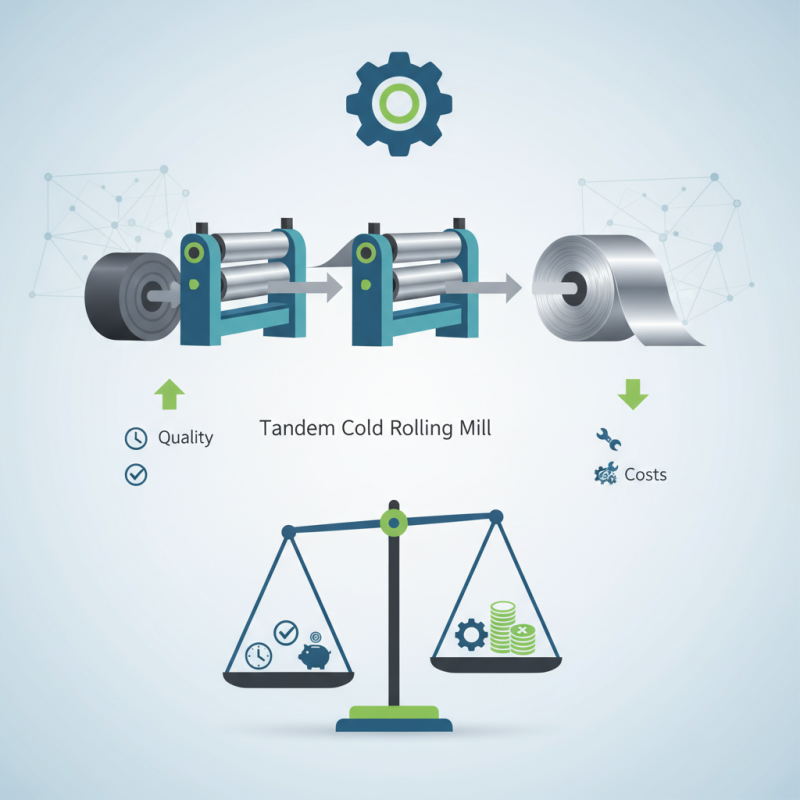
Why Choose a Tandem Cold Rolling Mill for Your Manufacturing Needs?
In today's competitive manufacturing landscape, choosing the right equipment is crucial. The tandem cold rolling mill is a powerful solution for producing high-quality metal sheets. This technology optimizes efficiency and ensures material integrity.
tandem cold rolling mills consist of multiple rolling stands. Each stand reduces the thickness of the material progressively. This process not only saves time but also enhances product consistency. Production can be streamlined, leading to significant cost savings.
However, the investment in a tandem cold rolling mill requires careful consideration. Maintenance and operational costs may be higher compared to traditional methods. Manufacturers must weigh these factors against the benefits. Ultimately, making an informed choice about this technology can lead to greater competitiveness in the market.
Key Advantages of Tandem Cold Rolling Mills in Manufacturing
Tandem cold rolling mills offer remarkable advantages for manufacturers. These mills process metal sheets efficiently. They can handle various materials, providing flexibility in production. The continuous operation reduces downtime between rolling stages. This leads to increased productivity and lower operational costs. Manufacturers benefit from quicker turnaround times, enabling faster market responses.
The precision of tandem cold rolling is noteworthy. The thickness of the final product is consistently controlled. This results in a higher quality of output. Additionally, the surface finish is smoother compared to traditional methods. However, achieving perfect results can be challenging. Regular maintenance is crucial to avoid defects. Minor issues can multiply if not addressed quickly.
Energy efficiency is another significant benefit. Tandem mills typically consume less energy per ton of rolled sheet. This lowers overall operating expenses. However, manufacturers must consider initial setup costs. It’s vital to evaluate long-term benefits against upfront investments. Each manufacturing process is unique, requiring careful analysis before making a choice.
Operational Efficiency and Cost-Effectiveness of Tandem Cold Rolling
Tandem cold rolling mills are becoming increasingly popular in manufacturing. They offer significant operational efficiency and cost-effectiveness, which are crucial in today's competitive landscape. According to a recent industry report, these mills can reduce production costs by as much as 15%. This reduction stems from their ability to produce thinner and stronger metal sheets without extensive energy use.
Operational efficiency is a major highlight. A tandem cold rolling mill can produce up to 40% more material in the same time frame compared to traditional single-stand mills. The automation in these systems helps minimize labor costs, but there are still challenges. The setup and maintenance of tandem mills can be complex. This complexity can lead to downtimes, which disrupt optimal production flow. Maintaining equipment and having skilled operators is essential, but these factors can sometimes be overlooked.
Data also shows that nearly 25% of companies face difficulties in workforce training for this advanced technology. However, those that invest in training see a notable improvement in output quality. As industries evolve, the need for cost-effective and efficient solutions will continue to rise. Balancing the initial challenges with the long-term benefits may lead many manufacturers to reconsider their processes.
Operational Efficiency and Cost-Effectiveness of Tandem Cold Rolling Mills
Comparison of Tandem Cold Rolling Mills with Other Rolling Methods
Tandem cold rolling mills are increasingly favored for their efficiency and versatility in manufacturing. Compared to other rolling methods, they offer distinct advantages. A recent industry report highlights that tandem mills can achieve reductions of up to 95% in material thickness in a single pass. This is significantly higher than traditional single-stand processes, which often require multiple passes, leading to increased production times.
The operational efficiency of tandem mills stems from their ability to process strips continuously. In contrast, batch processing in older systems can lead to inconsistent quality and higher energy consumption. Reports from global steel associations indicate that tandem mills consume up to 30% less energy than conventional systems. However, the initial investment in tandem technology can be a barrier. Manufacturers must carefully assess the long-term benefits against these upfront costs.
Despite these advantages, there are challenges. Maintenance of tandem mills can be complex. Downtime can disrupt the production flow, impacting overall productivity. Furthermore, while tandem mills excel in producing thin gauges, they may not be ideal for all applications. This implies a need for manufacturers to critically evaluate their specific needs before making a choice. Balancing cost, efficiency, and the specific requirements of each production scenario remains a vital consideration.
Applications and Industries Benefiting from Tandem Cold Rolling
Tandem cold rolling mills have a wide array of applications across different industries. They are particularly essential in the metal processing sector. In 2021, the global cold rolling market size was valued at approximately $80 billion, and it is projected to grow by 4% annually. This indicates a growing demand for thinner and stronger materials.
The automotive industry benefits significantly from tandem cold rolling. Lightweight steel and aluminum sheets are critical for vehicle production. These materials help improve fuel efficiency and reduce emissions. Reports suggest that automakers have increasingly turned to cold-rolled products, looking for better performance and lower weight. The aerospace sector also relies on tandem cold rolling for producing high-strength alloys, necessary for airframes and components.
Challenges do exist in optimizing the rolling process. The maintenance of uniform thickness is crucial. Even minor deviations can lead to product rejection. Companies must invest in advanced quality control measures. This requires a continuous approach to refining processes, ensuring the best overall yield. The benefits are clear, but the refinement process can be complex.
Future Trends in Tandem Cold Rolling Mill Technology and Innovations
The landscape of tandem cold rolling mills is evolving rapidly. Recent reports indicate a marked increase in automation within the industry. Automation boosts efficiency, but it requires skilled operators to manage complex systems. The balance between technology and human expertise remains a challenge.
Emerging technologies, like AI and IoT, are driving tailored solutions. These innovations enhance process control and reduce waste. Reports suggest that companies adopting smart technologies can cut production costs by 10-20%. However, integrating these technologies can be difficult. Many manufacturers struggle with legacy systems.
Tips: Invest in training your workforce to handle advanced technologies. This helps in maximizing the potential of new equipment. Consider phasing in tech upgrades. It allows for smoother transitions and minimizes production disruptions. Ultimately, understanding future trends in tandem cold rolling mills is vital for long-term success.
Why Choose a Tandem Cold Rolling Mill for Your Manufacturing Needs?
| Feature | Benefit | Future Trends |
| Energy Efficiency | Lower production costs | Advanced energy recovery systems |
| Automation | Reduced labor costs | Integration of IoT technologies |
| Product Quality | High precision materials | Real-time quality monitoring |
| Versatility | Ability to process a variety of materials | Enhanced dual-material processing capabilities |
| Maintenance | Lower downtime | Predictive maintenance using AI |