

Choosing a Heavy Duty Cable Reel is not just a matter of comparing prices. In factories, ports, construction sites, and service vehicles, the wrong reel can slow work or create avoidable maintenance problems. Cable weight, travel distance, operating speed, and exposure to dust or moisture all affect the right design. Small details matter.
This guide introduces ten China-based manufacturers for buyers who need reels built for demanding use. It offers a practical starting point, not a universal ranking: product ranges and capabilities can change, and a supplier that suits one project may not suit another. The comparison should consider reel capacity, cable type, spring or motor drive, slip-ring configuration, enclosure protection, customization, and documented quality controls. Ask for drawings and test records. Confirm that specifications match your actual load and duty cycle, rather than relying on a broad “heavy duty” label.
There is more to check. Request references for similar applications, clarify lead times and spare-parts support, and review sample units where practical. A clean product photo cannot show how a reel behaves after months of repeated winding. Nor does a factory’s location prove its engineering strength. Buyers should verify claims directly and record open questions before placing an order. This overview can narrow the field, but careful technical review remains essential. Manufacturers vary, and sometimes the best choice is not the most familiar name.
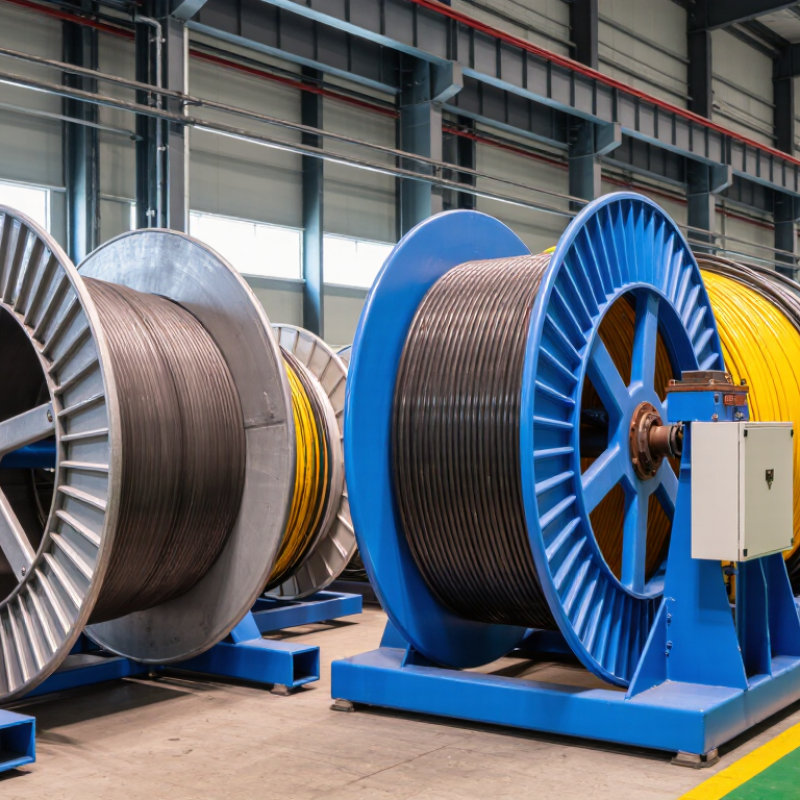
A heavy-duty cable reel stores and pays out flexible power cable while limiting tangles, abrasion, and trip hazards. Its frame supports a drum, bearings, and usually a rotating electrical connection called a slip ring. As the drum turns, cable winds onto or off it; the slip ring maintains electrical contact between the moving drum and fixed supply. Simple in principle. The details matter.
Manual reels use a handle, while spring-driven or motorized models manage return and tension differently. In practice, cable length, conductor size, load, and duty cycle all affect safe operation. A partly wound cable can retain heat under load, so checking the manufacturer’s rated current and allowable operating conditions is essential. IEC 60204-1 addresses electrical equipment of machinery, including protection and wiring principles; it is a useful technical reference, not a substitute for reel-specific instructions. The IEA’s Electricity 2024 report forecasts global electricity demand growth averaging 3.4% annually in 2024–2026. That signals expanding electrical demand, but it does not directly measure cable-reel sales. One assumption deserves a second look: a larger drum alone does not mean greater capacity. Pay attention to cable gauge, bend radius, and heat dissipation.
Heavy-duty cable reels store, deploy, and retrieve electrical cable in demanding environments. The comparison below covers ten common reel configurations and operating principles; it is not a ranking of manufacturers.
| Reel Configuration | How It Works | Common Applications | Power or Signal Transfer | Key Selection Consideration |
|---|---|---|---|---|
| Spring-driven retractable reel | A wound spring stores energy as the cable is pulled out and rewinds it when the locking mechanism is released. | Workshops, service bays, and equipment stations where cable needs to be routinely extended and retracted. | Electrical models commonly use a slip-ring assembly so the cable can rotate while connected. | Check cable length, conductor rating, spring capacity, and whether the reel includes a reliable locking function. |
| Motor-driven power reel | An electric motor turns the drum to pay out or retrieve cable; controls may include a contactor, limit switch, or variable-speed drive. | Industrial machinery, production lines, and mobile equipment requiring powered cable management. | Slip rings can maintain an electrical connection between the rotating drum and stationary supply. | Match motor torque and speed to the cable load, winding pattern, duty cycle, and operating environment. |
| Hydraulic-driven reel | A hydraulic motor rotates the drum using pressurized fluid supplied by a hydraulic system. | Heavy mobile equipment and applications where a suitable hydraulic power source is available. | Electrical cable reels may use slip rings; hydraulic power drives the drum rather than carrying electrical current through it. | Confirm hydraulic pressure and flow requirements, drum torque, hose routing, and protection from contamination. |
| Hand-crank reel | An operator turns a crank, often through a gear reduction, to rotate the drum and control cable retrieval. | Portable equipment, temporary installations, and locations without a dedicated powered drive. | The cable may connect directly at its ends; rotating electrical service may require a suitable slip-ring arrangement. | Consider the effort required under load, gear ratio, handle clearance, and the need for a brake or drum lock. |
| Motorized take-up reel | A drive winds cable onto the drum as equipment moves or as cable is returned to a fixed point. | Traveling machinery and installations where slack cable must be collected in a controlled manner. | A slip ring is commonly used when electrical continuity is required during drum rotation. | Coordinate reel speed and torque with equipment travel speed and the changing effective drum diameter. |
| Constant-tension reel | A controlled drive or mechanical system applies managed tension as cable is paid out or retrieved. | Moving equipment where excessive slack or excessive cable pull could interfere with operation. | Electrical transfer during rotation typically requires a slip ring designed for the circuit. | Set tension within the cable’s permitted pulling limits and account for acceleration and changing cable layers. |
| Festoon-assisted cable reel | A reel works with a trolley-and-loop system; the festoon supports cable along a travel path while the reel manages cable storage or return. | Overhead cranes and other equipment traveling along a defined runway or track. | Power and control conductors remain within the moving cable system; reel connections depend on the installation design. | Check travel distance, cable bend radius, trolley spacing, and compatibility between the reel and festoon system. |
| Vehicle-mounted cable reel | A drum mounted on a vehicle stores cable for deployment and retrieval at the work site, manually or with a powered drive. | Service vehicles, emergency-response equipment, and temporary power or communications setups. | Connection arrangements vary; a rotating electrical connection may use a slip ring when required by the design. | Account for vehicle mounting loads, vibration, weather exposure, cable retention, and safe access to the drum. |
| Heavy-duty welding cable reel | A robust drum stores flexible welding cable and allows the operator to deploy the required working length. | Welding stations and industrial maintenance areas where cable organization and protection are important. | Electrical continuity through a rotating reel depends on the reel’s design; some arrangements connect the cable directly. | Verify current rating, conductor size, cable temperature limits, and whether the reel is rated for energized use. |
| Data and control cable reel | A reel manages communication or control cable; rotating connections may use electrical slip rings or, where specified, fiber-optic rotary joints. | Mobile machinery, inspection systems, and installations that need controlled deployment of signal cable. | Transfer method depends on the cable: electrical conductors use compatible contacts, while fiber requires optical rotary components. | Check signal type, bandwidth, shielding, bend radius, and compatibility of the rotary transfer components. |
Actual capacity, cable length, current rating, speed, and environmental protection depend on the specific reel design and cable. Confirm application requirements and manufacturer specifications before selection or installation.