
China’s aluminum window industry has expanded rapidly, but energy performance varies widely between manufacturers. This guide examines China’s top 10 energy efficient aluminum window manufacturers through practical, measurable criteria. The focus is not only on attractive frames or competitive prices. It considers thermal-break design, glazing options, air tightness, water resistance, hardware quality, and documented testing.
Energy efficient aluminum windows should reduce heat transfer without sacrificing ventilation, daylight, or daily usability. Experienced manufacturers often explain their thermal systems clearly, including polyamide strip width, frame depth, glass configuration, and sealing structure. Factory visits, project references, and production records can reveal more than polished brochures. Look for manufacturers that provide credible test reports, consistent quality control, and technical support after installation.
Details matter.
A reliable supplier should discuss U-values, solar heat gain, drainage channels, corner joints, and installation tolerances. These features become visible when rain meets a poorly sealed frame or when a room overheats beside south-facing glass. This article also recognizes that no ranking is perfect. Product performance depends on climate, building orientation, glass selection, installation skill, and maintenance. A strong factory may still be unsuitable for a specific project. Therefore, readers should compare verified data, request samples, and clarify warranty responsibilities before choosing. The selected companies represent promising options, not automatic guarantees. Practical evidence should guide the final decision.
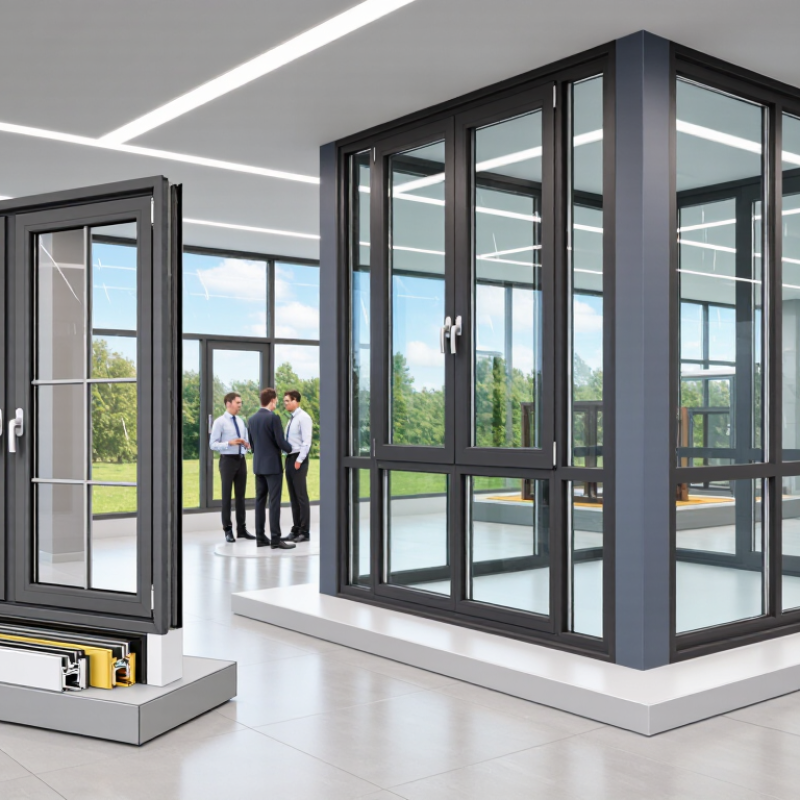
China Top 10 Energy Efficient Aluminum Window Manufacturers
Energy-efficient aluminum windows should be judged by measured performance, not frame appearance. The U-value shows heat transfer through the complete window. Lower values usually mean better insulation. The U.S. Department of Energy reports that windows can influence 25–30% of household heating and cooling energy use. This makes glazing, spacers, seals, and thermal breaks equally important.
SHGC measures how much solar heat enters through the glass. A lower SHGC can reduce summer cooling loads, especially on west-facing windows. However, colder climates may benefit from a higher SHGC during winter. NFRC rating procedures separate U-factor and SHGC testing, helping buyers compare products under consistent conditions. Air leakage matters too. NFRC 400 testing commonly reports leakage in cubic feet per minute per square foot at 75 Pa. Lower leakage improves comfort near the frame.
Tips: Request the complete-window NFRC label, not only center-glass data. Check U-value and SHGC for your climate zone. Ask for air-leakage results from accredited testing. Installation still matters. A well-rated window can perform poorly when perimeter foam is uneven or drainage paths are blocked. In practice, I would inspect corner joints and gasket compression before trusting a brochure. A perfect rating is not enough. Manufacturers should also explain tolerances, hardware adjustment, and field-service procedures. Some specifications look impressive, yet real buildings remain drafty. That gap deserves careful questioning.
| No. | Energy-Efficiency Window Profile | Aluminum Frame & Thermal Break | Glazing Configuration | Frame + Glazing U-Value W/m²·K | Solar Heat Gain Coefficient SHGC | Air Leakage at 10 Pa m³/(h·m²), maximum | Typical Climate / Application |
|---|---|---|---|---|---|---|---|
| 1 | High-performance passive-house casement | PA66 glass-fiber thermal break, approximately 75 mm frame depth | Triple insulating glass, Low-E coatings, argon fill, warm-edge spacer | 0.75–1.00 | 0.30–0.45 | ≤ 0.50 | Cold regions and very low-energy buildings |
| 2 | Low-U-value residential casement | PA66 thermal break, approximately 70 mm frame depth | Triple glazing, double Low-E, argon fill | 0.90–1.20 | 0.25–0.40 | ≤ 0.75 | Cold and mixed climates |
| 3 | Balanced all-climate casement | PA66 thermal break, approximately 65 mm frame depth | Double insulating glass, Low-E coating, argon fill | 1.30–1.70 | 0.30–0.50 | ≤ 1.00 | General residential and commercial use |
| 4 | Solar-control mixed-climate casement | PA66 thermal break with multi-chamber frame | Double glazing, spectrally selective Low-E, argon fill | 1.40–1.80 | 0.22–0.35 | ≤ 1.00 | Hot-summer and mixed-humid climates |
| 5 | High-solar-gain winter climate window | PA66 thermal break, insulated frame chambers | Double glazing, clear or mild Low-E, argon fill | 1.45–1.90 | 0.45–0.60 | ≤ 1.00 | Heating-dominated northern climates |
| 6 | Thermally improved lift-and-slide door | Deep PA66 thermal break with insulated track zone | Double or triple insulating glass, Low-E, argon fill | 1.40–2.00 | 0.25–0.45 | ≤ 1.50 | Large openings where daylight and access are priorities |
| 7 | Narrow-frame thermal-break casement | PA66 thermal break, approximately 55–60 mm frame depth | Double glazing, Low-E coating, argon fill | 1.60–2.10 | 0.30–0.50 | ≤ 1.50 | Renovation projects with limited frame depth |
| 8 | Hot-climate solar-control window | PA66 thermal break with exterior drainage and pressure-equalized design | Double solar-control Low-E glazing, argon fill | 1.50–2.00 | 0.20–0.30 | ≤ 1.00 | Cooling-dominated southern and coastal climates |
| 9 | Acoustic and thermal comfort window | PA66 thermal break with continuous compression seals | Asymmetric double glazing, laminated acoustic pane, Low-E coating | 1.50–2.00 | 0.25–0.45 | ≤ 0.75 | Urban buildings exposed to traffic noise and wind |
| 10 | Cost-optimized energy-efficient window | Standard PA66 thermal break, approximately 55 mm frame depth | Double glazing with single Low-E coating and argon fill | 1.80–2.40 | 0.30–0.55 | ≤ 1.50 | Standard residential replacement projects |
This ranking measures performance, not advertising claims. U-factor receives the highest weight because lower values indicate less heat transfer through the complete window. The U.S. Department of Energy reports that windows can influence 25–30% of household heating and cooling energy use. Therefore, small improvements matter in dense residential projects.
EN 12207 air-tightness forms the second core test. Class 4 represents the strongest classification, with leakage assessed under controlled pressure differences. A tighter window reduces drafts, dust entry, and uncontrolled cooling loss. Test certificates should identify the complete assembly, not only the frame. That detail is often missed.
Thermal-break performance receives equal practical attention. Reviewers should examine polyamide strip width, insulation continuity, frame Uf values, and linear thermal transmittance at joints. EN ISO 10077-2 supports calculation of thermal transmittance, while EN 14024 addresses thermally broken profiles. The International Energy Agency notes that buildings account for roughly 30% of global final energy demand, making envelope quality commercially significant. Still, a neat ranking can mislead. Installation gaps, glass selection, drainage design, and factory tolerances may weaken excellent laboratory results. Field evidence should therefore confirm the numbers. Some manufacturers provide incomplete data. That deserves a lower position.
China’s Top 10 Energy-Efficient Aluminum Window Manufacturers are often evaluated through materials, testing, and project experience. Strong manufacturers use thermally broken aluminum profiles, insulated glazing, warm-edge spacers, and durable sealing systems. These details reduce heat transfer around the frame and glass.
Performance must be measured, not simply advertised. Reliable factories provide U-value data, air-tightness results, water resistance records, and wind-load testing. Some also conduct thermal imaging checks after installation. A well-designed window should feel less cold near the frame during winter. It should also limit indoor heat gain during hot summers. Small details matter.
Many leading manufacturers offer customized glazing, low-emissivity coatings, multi-point locks, and recyclable aluminum systems. Their technical teams can review wall thickness, opening size, drainage, and local climate conditions. That practical support can prevent expensive installation errors. Still, no factory is perfect. A lower U-value alone may hide weak sealing or poor fitting. Buyers should compare complete test reports, warranty terms, production samples, and project references. Factory visits can reveal more than polished brochures, including storage conditions, quality checks, and assembly discipline.
Product Evidence: Low-E Glazing, Thermal Breaks, and Uw ≤ 1.4 W/m²·K
Selecting among China’s top ten energy efficient aluminum window manufacturers requires more than attractive catalog figures. Reliable suppliers should provide complete test reports for the actual window configuration. These reports should identify the frame, sash, glass, spacer, hardware, and installation method. A Uw value of 1.4 W/m²·K or lower indicates strong thermal performance, but the result depends on the whole unit, not the glass alone.
Low-E glazing reduces radiant heat transfer through a microscopically thin coating. In colder climates, it helps retain indoor warmth. In hotter regions, a suitable solar-control coating can limit unwanted heat gain.
Thermal breaks are equally important. Polyamide strips separate the inner and outer aluminum sections, reducing conductive heat flow through the frame. Look for continuous insulation, tight corner joints, and tested air leakage data.
Details matter.
During supplier evaluations, request sample windows and inspect the corners, gaskets, drainage paths, and locking pressure. A laboratory result may not survive poor installation, uneven openings, or compressed insulation.
This is where rankings become less certain. Manufacturers should explain testing standards, production tolerances, and quality checks rather than relying on marketing claims. Independent verification, traceable documents, and consistent batch records offer stronger evidence of expertise and reliability. Even a well-designed window can perform poorly when installers ignore perimeter sealing.
China Top 10 Energy Efficient Aluminum Window Manufacturers
A credible comparison should begin with evidence, not attractive product photos. Check current certifications, issuing bodies, test dates, and model numbers. Common documents include ISO 9001, ISO 14001, CE-related declarations, and market-specific energy ratings. However, a certificate alone proves little about one window series. Ask for laboratory reports covering U-value, air leakage, water penetration, wind resistance, and sound insulation. The report should match the proposed profile, glass package, hardware, and dimensions. Small differences matter.
Export experience also deserves careful review. A manufacturer shipping to Europe may understand different requirements from one serving North America, Australia, or the Middle East. Request recent shipment references, packaging photos, installation manuals, and customs documentation. Buyer comparisons should measure thermal performance, warranty terms, lead time, minimum order quantity, and replacement support. Calculate the complete cost, including glazing, delivery, installation, and possible testing fees.
Do not rank suppliers by factory size alone. A large facility can still provide weak technical communication. I have seen polished samples perform differently after installation. That is easy to overlook. Ask for corner samples, drainage details, thermal-break thickness, and condensation guidance. Independent verification is worth the extra time. One weakness remains: public test data may be incomplete or difficult to compare directly. Treat every ranking as a shortlist, then confirm performance through project-specific samples and written documentation.
Certifications, Test Reports, Export Markets, and Buyer Comparisons
Source basis: ENERGY STAR® Residential Windows, Doors, and Skylights Version 7.0 performance criteria. Regional values shown are maximum permitted U-factors.