2026 Best 3D CNC Automatic Tube Bending Machine Price
Choosing the 2026 Best 3D CNC Automatic Tube Bending Machine Price means looking beyond the number on a quotation. A machine may bend stainless steel, aluminum, or mild-steel tubing, yet its real value depends on tube diameter, wall thickness, bend radius, and production volume. Buyers should compare those requirements with the machine’s capacity, tooling package, software, and service support. Small details matter. A worn clamp or poorly matched mandrel can leave visible marks or cause a bend to drift.
A useful purchasing principle is simple: “Price matters only when the machine can repeat the bend.” This is an editorial summary, not a quotation attributed to a named expert. No source article or verified expert statement was provided, so assigning a quotation to an industry professional would risk misrepresenting them. For a dependable comparison, request a sample bend using your actual tube material and dimensions. Check the finished part for angle consistency, surface condition, and fit against the drawing. Ask whether installation, operator training, spare parts, and warranty coverage are included.
This guide examines the factors that shape machine prices, from basic configurations to advanced multi-axis systems. It also explains what to confirm before requesting a quote. A lower upfront cost can be attractive. It may not be the lowest cost over time. Consider production needs carefully, and leave room for uncertainty: actual pricing varies by specification, supplier, and service package.
What Defines a 3D CNC Automatic Tube Bending Machine in 2026?
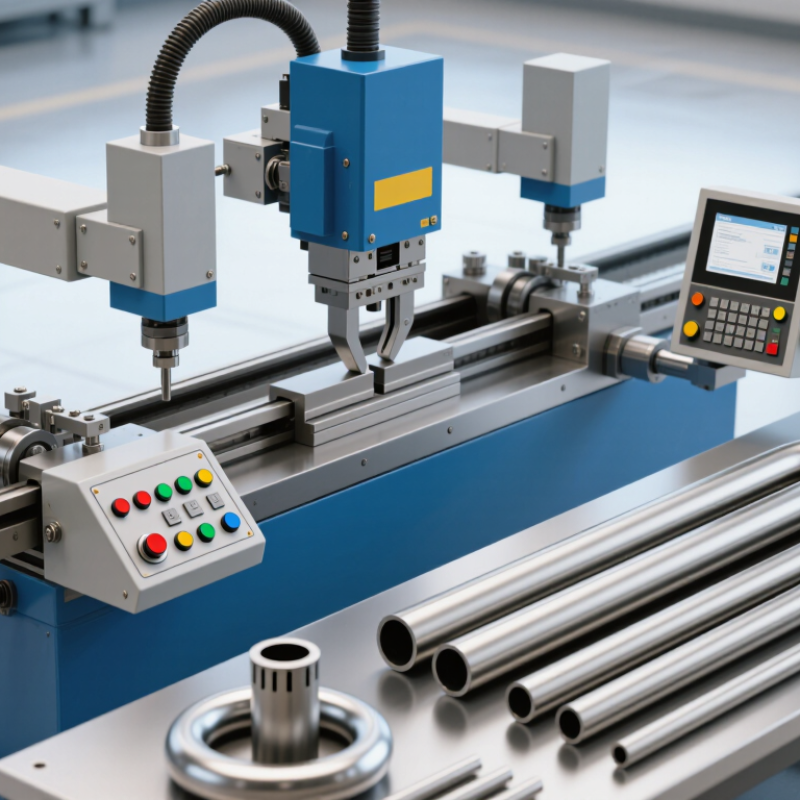
A 3D CNC automatic tube bending machine coordinates tube feeding, rotation, and bending. It forms bends across multiple planes, not just one flat plane. The control stores programs and repeats feed lengths, rotation angles, and bend angles. That is the practical distinction. Automation also includes controlled clamping and bending sequences, with sensors or alarms helping operators spot process issues.
On a shop floor, an operator loads a straight tube, selects a program, and checks the first part against a drawing or gauge. A typical setup may use a mandrel to limit flattening, plus a pressure die to support the tube wall. Material, outside diameter, wall thickness, and bend radius all affect the result. Small setup differences matter. A polished sample does not prove every batch will match.
These features also shape the 2026 price. A machine configured for larger diameters, tighter radii, more axes, or faster changeovers generally requires more capability and tooling. Compare usable capacity, repeatability, included tooling, and service support—not just the quoted machine cost. Automation is not magic. Tooling still needs careful setup, and operators must verify parts. Buyers sometimes overlook that detail; it can be an expensive mistake.
Key Specifications: Tube Diameter, Wall Thickness, Bend Radius, and CNC Axes
For a 2026 3D CNC automatic tube bending machine, price comparisons mean little without matching the working envelope. Grand View Research valued the global CNC machine market at USD 101.22 billion in 2023 and forecast 9.5% annual growth through 2030. That broad market figure is useful context, not a tube-bender price benchmark. Ask suppliers to quote the same tube material, tooling, software, and automation package.
Tube diameter and wall thickness define the machine’s real capacity. A machine rated for 50 mm tubing may not bend thick-wall stainless steel at that diameter. Request capacity charts by material and thickness, plus sample bends using your actual tube. Small differences matter. Bend radius should be stated as centerline radius, not merely “minimum radius”; tight bends can require specialized tooling and may cause flattening or wrinkling. Check the allowable radius for each tube size.
CNC axes also affect cost and flexibility. Confirm which axes are independently controlled, such as feed, rotation, and bending, and whether the quoted configuration supports 3D parts. More axes can reduce manual repositioning, but they do not guarantee better accuracy. I would treat a catalog specification as a starting point, not a promise. Ask for repeatability data, cycle-time assumptions, and a trial bend before comparing final prices.
2026 Best 3D CNC Automatic Tube Bending Machine Price
Indicative budget ranges by tube capacity. Prices are planning estimates, not supplier quotations.
Typical specification bands: Compact: 25–40 mm tube diameter, 1–2 mm wall, 1.5D–3D bend radius, 5–7 CNC axes. Mid-range: 40–60 mm, 2–3 mm, 1.5D–3D, 7–9 axes. Heavy-duty: 60–80 mm, 3–5 mm, 2D–4D, 9–11 axes. Actual capacity and price vary with material, tooling, controls, automation, and required bend geometry.
How Bending Quality Is Measured: Ovality = (Dmax − Dmin) ÷ Dnom × 100%
2026 Best 3D CNC Automatic Tube Bending Machine Price
Bending quality is easier to compare when ovality is measured consistently. Use this formula: Ovality (%) = (Dmax − Dmin) ÷ Dnom × 100%. Dmax and Dmin are the largest and smallest outside diameters measured at the same cross-section. For example, a 25 mm tube measuring 25.8 mm and 24.4 mm has 5.6% ovality. That number describes shape change, not the full quality of a bend. Check the bend radius, wall thinning, and repeatability too. A machine’s price matters less if its bends vary across a production run.
For credible measurements, record the instrument, tube temperature, and measuring position. NIST Technical Note 1297 explains that expanded uncertainty with a coverage factor of k = 2 corresponds to approximately 95% confidence under stated assumptions. ISO 15530-3 describes a calibrated-workpiece method for evaluating coordinate measuring machine uncertainty. These references reinforce a practical point: measurement uncertainty belongs in the inspection record. Still, one reading is not enough. Compare several sections and parts from the same setup.
Tips: Mark each measurement plane, rotate the tube gently, and avoid squeezing thin walls with the caliper. Keep the readings, even when they look untidy; they may reveal setup drift.
2026 Machine Price Factors: Capacity, Tooling, Automation, and Software
2026 Best 3D CNC Automatic Tube Bending Machine Price
Capacity is the first major price driver. A machine designed for larger tube diameters, thicker walls, or tighter bend radii needs more force and a stiffer frame. Ask for rated capacity across your actual material grades, not just the maximum diameter. One detail matters: maximum capacity does not guarantee the same speed or bend quality.
Tooling costs depend on tube diameter, material, bend radius, and production mix. A quote may include only one die set, while frequent changeovers can require additional dies, clamps, and mandrels. Automation also changes the investment. Automatic loading, unloading, and measurement can reduce manual handling, but add equipment, integration, and maintenance needs. The International Federation of Robotics reported 541,302 industrial robot installations worldwide in 2023, up 10% year over year, in its World Robotics 2024 report. That signals broad automation adoption, not a tube-bender price benchmark.
Software deserves a closer look. Confirm whether programming, 3D simulation, bend compensation, and production data tools are included or licensed separately. These features can reduce trial bends and scrap, but only when operators can use them well. A neat quote can still omit training, installation, or post-sale support. Request a sample program using your part drawing, then compare the same scope across suppliers. Small omissions add up. I would not assume the lowest initial price is the lowest operating cost.
How to Compare Machine Prices Against Output, Setup Time, and Total Cost of Ownership
A 2026 3D CNC automatic tube bending machine should be judged by accepted parts per shift, not its sticker price alone. Deloitte’s 2024 Smart Manufacturing Survey reported expected production-output gains of 10–20% among manufacturers investing in smart manufacturing. That is a sector-level expectation, not a promise from one bender. Measure your own baseline: finished bends per staffed hour, scrap rate, and first-part approval time. Count setup, too. A changeover may involve a new tool, program, clamp position, and test bend; minutes lost between small batches can erase an attractive purchase-price saving.
Compare five-year cost per accepted part. Include tooling, operator time, installation, energy, maintenance, software, financing, and downtime. NIST’s Handbook 135 life-cycle costing guidance treats costs across a system’s life, rather than purchase price alone. Ask suppliers to demonstrate your actual tube diameter, wall thickness, bend radius, and material, then record cycle and setup times. A faster cycle is not useful if adjustment creates more rejected parts.
There is an awkward caveat: estimates often assume steady production, while real orders change. Request service and spare-part costs in writing, and test the payback using your lower-volume months, not only your busiest week.

